 |
|
| Back to Home |
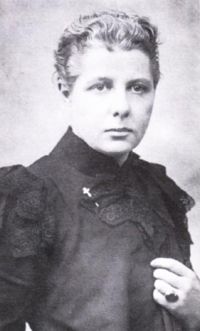
| Dr. Annie Besant |
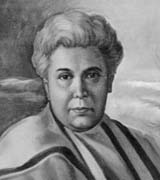 |
| Dr. Annie Besant is one
of those foreigners who inspired the love of the country among Indians.
She declared in 1918 in her paper "New India": "I love the Indian people
as I love none other, and... my heart and my mind... have long been laid
on the alter of the Motherland."Annie Besant, born of Irish parents in
London on October 1, 1847, made India her home from November, 1893. Dr.
Besant, said Mahatma Gandhi, awakened India from her deep slumber. Before
she came to India, Dr. Besant passed through several phases of life-housewife,
propagator of atheism, trade unionist, feminist leader and Fabian Socialist.
By 1889, "there was scarcely any modern reform (in England) for which she
had not worked, written spoken and suffered."Dr. Besant started the Home
Rule League in India for obtaining the freedom of the country and reviving
the country's glorious cultural heritage. She started a paper called "New
India." She attended the 1914 session of the Indian National Congress and
presided over it in 1917. She could not see eye to eye with Gandhiji in
regard to the latter's satyagraha movement.
An orator and writer with poetic temperament, Dr. Besant was a veritable tornado of power and passion. By her eloquence, firmness of convictions and utter sincerity she attracted some of the best minds of the country for the national cause. She was largely responsible for the upbringing of the world renowned philosopher K. Krishnamurti. Dr. Besant died in 1933. |
| Annie Wood was born in 1847
in London into a middle-class family of Irish origin. Annie was always
proud of being Irish and supported the cause of Irish self-rule throughout
her adult life.
Her father died when she was young and left the family almost penniless. Annie’s mother was forced to support the family by running a boarding house for boys at Harrow. She raised the money for a private tutor for Annie in this way. Annie was educated privately by a female tutor as an Evangelical Christian. She was given a strong sense of duty to society and an equally strong sense of what independent women could achieve. As a young woman, Annie was also able to travel widely in Europe. There she acquired a taste for Catholic colour and ceremony that never left her. She was married in 1867 in Hastings, Sussex, to 26-year-old clergyman Frank Besant, younger brother of Walter Besant. He was an Evangelical Anglican clergyman who seemed to share many of her concerns. Soon Frank became vicar of Sibsey in Lincolnshire. Annie moved to Sibsey with him, and within a few years they had two children: Digby and Mabel. The marriage was, however, a disaster. The first conflict came over money and Annie’s independence. Annie wrote short stories, books for children and articles. Frank took all the money she made: married women did not have the right to own property. Politics further divided the couple. Annie began to support farm workers who were fighting to unionise and to win better conditions. Frank was a Tory and sided with the landlords and farmers. The tension came to a head when Frank struck Annie. She left him and returned to London. Annie began to question her own faith. She turned to leading churchmen for advice. She even went to see Dr Pusey, leader of the Catholic wing of the Church of England. He simply told her she had read too many books. Annie returned to Frank to make one last effort to repair the marriage. It proved useless. She finally left for London. Divorce was unthinkable for Frank, and was not really within the reach of even middle-class people. Annie was to remain Mrs Besant for the rest of her life. At first, she was able to keep contact with both children and to have Mabel live with her. She got a small allowance from Frank. Her husband was given sole custody of their two children.
|
| She fought for the causes
she thought were right, starting with freedom of thought, women's rights,
secularism (she was a leading member of the National Secular Society alongside
Charles Bradlaugh), birth control, Fabian socialism and workers' rights.
Once free of Frank Besant and exposed to new currents of thought, Annie began to question not only her long-held religious beliefs but also the whole of conventional thinking. She began to write attacks on the Churches and the way they controlled people’s lives. In particular she attacked the status of the Church of England as a state-sponsored faith. Soon she was earning a small weekly wage by writing a column for the National Reformer, the newspaper of the National Secular Society. The Society stood for a secular state: an end to the special status of Christianity. The Society allowed her to act as one of its public speakers. Public lectures were very popular entertainment in Victorian times. Annie was a brilliant speaker, and was soon in great demand. Using the railway, she criss-crossed the country, speaking on all of the most important issues of the day, always demanding improvement, reform and freedom. For many years Annie was a friend of the Society’s leader, Charles Bradlaugh. It seems that they were never lovers, but their friendship was very close indeed. Bradlaugh, a former seaman, had long been separated from his wife. Annie lived with Bradlaugh and his daughters, and they worked together on many issues. Bradlaugh was an atheist and a republican. He was working to get himself elected as MP for Northampton to gain a better platform for his ideas. Besant and Bradlaugh became household names in 1877 when they published a book by the American birth-control campaigner Charles Knowlton. It claimed that working-class families could never be happy until they were able to decide how many children they wanted. It suggested ways to limit the size of their families. The Knowlton book caused great offence to the Churches, but Annie and Bradlaugh proclaimed in the National Reformer: "We intend to publish nothing we do not think we can morally defend. All that we publish we shall defend." The couple were arrested and put on trial for publishing the Knowlton book. They were found guilty, but released pending appeal. As well as great opposition, Annie and Bradlaugh also received a great deal of support in the Liberal press. Arguments raged back and forth in the letters and comment columns as well as in the courtroom. For a time, it looked as though they would be sent to prison. The case was thrown out finally only on a technical point: the charges had not been properly drawn up. The scandal lost Annie her children. Frank was able to persuade the court that she was unfit to look after them, and they were handed over to him permanently. Bradlaugh’s political prospects were not damaged by the Knowlton scandal. He got himself into Parliament at last in 1881. Because of his atheism, he refused to swear the oath of loyalty. Although many Christians were shocked by Bradlaugh, others (like the Liberal leader Gladstone) spoke up for freedom of belief. It took more than six years before the whole issue was sorted out (in Bradlaugh’s favour) after a series of by-elections and court appearances. Meanwhile Besant built close contacts with the Irish Home Rulers and gave them support in her newspaper columns. These were crucial years, in which the Irish nationalists were forming an alliance with Liberals and Radicals. Annie met the leaders of the movement. In particular, she got to know Michael Davitt, who wanted to mobilise the Irish peasantry through a Land War: a direct struggle against the landowners. She spoke and wrote in favour of Davitt and his Land League many times over the coming decades. However, Bradlaugh's parliamentary
work gradually alienated Annie. Women had no part in parliamentary politics.
Annie was searching for a real political outlet: politics where her skills
as a speaker writer and organiser could do some real good.
|
| For Annie, politics, friendship
and love were always closely intertwined. Her decision in favour of Socialism
came about through a close relationship with George Bernard Shaw, a struggling
young Irish author living in London, and a leading light of the Fabian
Society. Annie was impressed by his work and grew very close to him too
in the early 1880s. It was Annie who made the first move, by inviting Shaw
to live with her. This he refused, but it was Shaw who sponsored Annie
to join the Fabian Society. In its early days, the Society was a gathering
of people exploring spiritual, rather than political, alternatives to the
capitalist system.
Annie now began to write for the Fabians. This new commitment - and her relationship with G.B.S. - deepened the split between Annie and Bradlaugh, who was an individualist and opposed to Socialism of any sort. While he would defend free speech at any cost, he was very cautious about encouraging working-class militancy. Unemployment was a central issue of the time, and in 1887 some of the London unemployed started to hold protests in Trafalgar Square. Annie agreed to appear as a speaker at a meeting on 13 November. The police tried to stop the assembly. Fighting broke out, and troops were called. Many were hurt, one man died, and hundreds were arrested. Annie offered herself for arrest, but the police refused to take the bait. The events created a great sensation, and the newspapers dubbed it ‘Bloody Sunday’. Annie was widely blamed - or credited - for it. She threw herself into organising legal aid for the jailed workers and support for their families. Bradlaugh finally broke with her because he felt she should have asked his advice before going ahead with the meeting. Socialists saw the trade unions as the first real signs of working people’s ability to organise and fight for themselves. Until now, trade unions had been for skilled workers - men with a craft that might take years to acquire and which gave them at least a little security. The Socialists wanted to bring both unskilled men and women into unions to fight for better pay and conditions. Her most notable victory in this period was perhaps her involvement in the London matchgirls strike of 1888. Annie was drawn into this first really important battle of the ‘New Unionism’ by Herbert Burrows, a young socialist with whom she was for a time in love. He had made contact with workers at Bryant and May’s match factory in Bow, London, who were mainly young women. They were very poorly paid. They were also prey to horrendous industrial illnesses, like the bone-rotting Phossy jaw, which were caused by the chemicals used in match manufacture. Some of the match workers asked for help from Burrows and Annie in setting up a union. Annie met the women and set up a committee, which led the women into a strike for better pay and conditions. The action won enormous public support. Annie led demonstrations by ‘match-girls’. They were cheered in the streets, and prominent churchmen wrote in their support. In just over a week they forced the firm to improve pay and conditions. Annie then helped them to set up a proper union and a social centre. At the time, the matchstick industry was an immensely powerful lobby, since electric light was not yet widely available, and matches were essential for lighting candles, oil lamps, gas lights and so on. (Only a few years earlier in 1872, lobbyists from the match industry had persuaded the British government to change its planned tax policy.) Besant's campaign was the first time anyone had successfully challenged the match manufacturers on a major issue, and was seen as a landmark victory of the early years of British Socialism. |
| Back to Home |
|
||||
 |
 |
 |
 |
 |