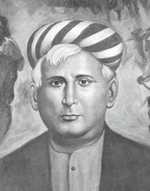
| Bankim Chandra Chatterjee, born on June
26, 1838, was educated at the Hoogly College and belonged to an orthodox
family. He was offered the government post of Deputy Magistrate and Collector
which he accepted and held until he retired 1891.
He did for Bengali fiction what Michael
Madhusudan Dutt had done for Bengali poetry, that is, he brought in imagination.
Chatterjee was more fortunate than Dutt as he did not have to set up his
own diction from the very start. The prose style was already standardized;
what Chatterjee did was to break its monotony, shear off its ponderous
verbosity and give it a twist of informality and intimacy. Chatterjee's
own style grew up as he went on writing.
Chatterjee, following the discipline of
Isvarchandra Gupta, began his literary career as a writer of verse. Fortunately
he was not slow to feel that poetry was not his metier. He then turned
to fiction. His first attempt was a novel in Bengali submitted for a declared
prize. The prize did not come to him and the novelette was never published.
His first fiction to appear in print was Rajmohan's Wife. It was written
in English and was probably a translation of the novelette submitted for
the prize. Durgeshnandini, his first Bengali romance, was published in
1865. The next novel Kapalkundala(1866) is one of the best romances written
by Chatterjee. The theme is lyrical and gripping and, in spite of the melodrama
and the dual story, the execution is skillful. the heroine, named after
the mendicant woman in Bhavabhuti's Malatimadhava , is modelled partly
after Kalidasa's Sakuntala and partly after Shakespeare's Miranda.
The next romance Mrinalini(1869) indicates
an ameturishness and a definite falling off from the standard. It is a
love romance against a historical background sadly neglected and confused.
After this Chatterjee was not content to continue only as a writer of prose
romances, but appeared also as a writer with the definite mission of simulating
the intellect of the Bengali speaking people through literary campaign
and of bringing about a cultural revival thereby. With this end in view
he brought out monthly Bangadarshan in 1872. In the pages of this magazine
all his writings except the very last two works first came out. These writings
include novels, stories, humorous sketches, historical and miscellaneous
essays, informative articles, religious discourses, literary criticisms
and reviews. Vishbriksha (The poison Tree, 1873) was his first novel to
appear serially in Bangadarshan.
Chandrasekhar (1877) suffers markedly from
the impact of two parallel plots which have little common ground. The scene
is once shifted back to eighteenth century. But the novel is not historical.
The plot has suffered from the author's weakness for the occult. The next
novel Rajani(1877) followed the autobiographical technique of Wilkie Collins'
A Woman in White. The title role was modelled after Bulwar Lytton's Nydia
in Last Days of Pompeii. In this romance of a blind girl, Chatterjee is
at his best as a literary artist. In Krishnakanter Uil (Krishnakanta's
Will, 1878) Chatterjee added some amount of feeling to imagination, and
as a result it approaches nearest to the western novel. The plot is somewhat
akin to that of Poison Tree.
The only novel of Chatterjee's that can
claim full recognition as historical fiction is Rajsimha (1881, rewritten
and enlarged 1893). Anandamath (The mission house of the Anandas, 1882)
is a political novel without a sufficient plot. It definitely marks the
decline of Chatterjee's power as a novelist. The plot of the meagre story
is based on the Sannyasi rebellion that occurred in North Bengal in 1773.
As fiction it can not be called an outstanding work. But as the book that
interpreted and illustrated the gospel of patriotism and gave Bengal the
song "Bande Mataram" (I worship mother) which became the mantra of nationalism
and the national song. Incidentally it gave tremendous impetus to the various
patriotic and national activities culminating in the terrorist movement
initiated in Bengal in the first decade of the twentieth century.
Devi Caudhurani by Chatterjee was published
in 1884. The story is romantic and interesting and delightfully told, no
doubt. Chatterjee's last novel Sitaram (1886) has for its theme the insurgence
of a Hindu chief of lower central Bengal against the impotent Muslim rule.
The central figure is well delineated but the other figures are either
too idealistic or impalpable.
After the novels, the humorous sketches
are the outstanding productions of Chatterjee. Kamalakanter Daptar (The
Scribbling of Kamalakanta, 1875; enlarged as Kamalakanta, 1885) contains
half humorous and half serious sketches somewhat after De Quincey's Confessions
of an English Opium-eater. It shows the writer at his best.
Bankim Chatterjee was superb story-teller,
and a master of romance. He is also a great novelist in spite of the fact
that his outlook on life was neither deep nor critical, nor was his canvas
wide. But he was something more than a great novelist. He was a path finder
and a path maker. Chatterjee represented the English-educated Bengalee
with a tolerably peaceful home life, sufficient wherewithal and some prestige,
as the bearer of the torch of western enlightment. No Bengali writer before
or since has enjoyed such spontaneous and universal popularity as Chatterjee.
His novels have been translated in almost all the major languages of India,
and have helped to simulate literary impulses in those languages.
Bankim Chandra Chatterjee passed away on
April 8, 1894.
|