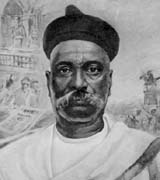
The next three years
saw meteoric rise in his stature and the British power which had long since
considered him their chief concern and had sent him to prison twice already,
decided on a firmer measure. Much has been said of his trial of 1908. He
utilized his time in prison in scholarly pursuits and wrote "GitaRahasya",
a commentary on the Gita. He returned to Indian political scene in 1915.
The political situation was fast changing under the shadow of World War
I. Mahatma Gandhi's star was on rise with Satyagraha at Sabarmati in 1914.
The British charged Tilak
in 1918. He fought those charges both in India and England, and was judged
guilty. Amidst rumors of yet another sentence, he headed the Home-Rule
commission in England to debate India's constitutional demands. By that
time, Gandhi had made preparations of the first nation wide non-cooperation
movement and, perhaps, it was to make way for Gandhi that Tilak left for
England. Tilak was, probably, the only leader who could have put brakes
on Gandhi. Both had conflicting approaches. Gandhi had the courage to address
and solve the issue of untouchability once and forever. He, unlike Tilak,
was a fluent speaker in Hindi and could thus reach the masses more easily.
It is no secret that he had little respect for Tilak's real politick and
Tilak hated adopting means which killed self pride of the masses. Whereas
Gandhi preached, "Overcome hatred with love", Tilak pooh poohed moderates
saying, "There is no empire lost by a free grant of concession by the rulers
to the ruled." In both world wars, Gandhi encouraged Indians to fight for
the British Empire unconditionally whereas Tilak held that if Indians were
to remain slaves then it mattered little whether they joined army or not.
The Mahatma was modern with novel methods. His was a welcome arrival both
for the Moderates who needed an answer to the Extremists and Tilak, in
particular, and the British who would rather acknowledge and have a saint
as the foremost adversary.
In the 20's many of Tilak's
followers, Dadasaheb Khaparde and N.C. Kelkar being the most prominent
among them, supported Gandhi but none could have his say in the new order.
Aurobindo Ghosh had retired to an ascetic life and Savarkar was serving
two life sentences in Andaman. The Lokamanya had no worthy successor. Tilak's
health continued to deteriorate rapidly at end of July 1920 and he went
delirious and was unconscious for 3 days. His last words in the final momentary
recovery were, "This happened in 1818 (End of Peshwai) and this in 1918.
A hundred years' history - what a life of servitude...Unless Swaraj is
obtained, India shall not prosper. It is necessary for our very own existence."
At 00:40 hrs (IST) on Aug
1, 1920, he was declared dead. It is said that the British made an extraordinary
request that his brain be handed over to them so that it could be studied,
preserved and exhibited. It was not complied with.