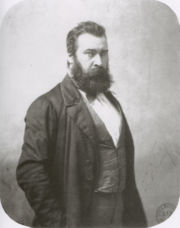
Jean-François
MILLET
1814 - 1875
France
Millet was born at Grouchy (Manche) and
was a pupil of Paul Delaroche
in Paris by 1837. For some years he painted
chiefly idylls in imitation
of 18th-century French painters. Becoming,
like Daumier, increasingly
moved by the spectacle of social injustice,
Millet turned to peasant subjects and
won his first popular success at the Salon
of 1848 with The Winnower.
From the following year he was chiefly
active at Barbizon and associated with
the Barbizon school of landscape
painters. His work was influenced by
Dutch paintings of the 17th century and
by the work of Chardin, and
was influential in Holland on Israëls
and on the early style of Van Gogh.
The Whisper
Jean-François MILLET
about 1846
The Winnower
Jean-François MILLET
about 1847-8
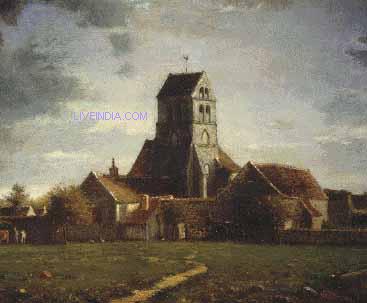
Landscape …, Jean-François MILLET
(Follower), after 1870

Landscape
with Buildings
Jean-François
MILLET1 (Follower)
Painted 1837-75
Signed or inscribed:
F. Millet,
followed by an illegible
date.
Canvas, 36.8 x 44.5
cm
Bequeathed by Sir
Victor Wellesley, 1954.
There is an inscription
on fragments of
paper on
the reverse: 'des
environs de/ Fontainebleau par/. . .llet',
which implies the
picture
is probably of somewhere
around Fontainebleau.
Jean-François Millet
(October 4, 1814 – January 20, 1875) was a painter and one of the founders
of the Barbizon school in rural France. He is noted for his scenes of peasant
farmers. He can be categorized as part of the movement termed "naturalism",
but also as part of the movement of "realism".
Born in the village of Gruchy,
in Gréville-Hague (Normandy), Millet moved to Paris in 1838. He
received his academic schooling with Paul Dumouchel, and with Jérome
Langlois in Cherbourg. After 1840 he turned away from the official painting
style and came under the influence of Honoré Daumier. In 1849 he
withdrew to Barbizon to apply himself to painting many, often poetic, peasant
scenes.