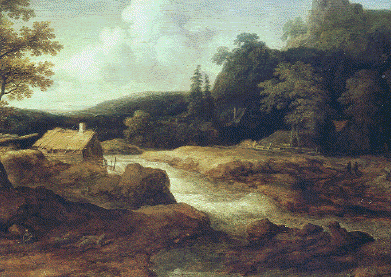


This example was painted late in his career, in
about 1670.
A Saw-mill by a Torrent
2.
Andrea MANTEGNA
1430/1 - 1506 Italy
Mantegna made this bronze self portrait for his burial
chapel.
It emulates great figures of antiquity: a crown of
laurel is associated with Caesar and the coronation of poets. He claims
that his art elevates him to comparable status.
Mantegna achieved a renown unparalleled by living
artists in the 15th century.
It was akin to the fame and status of artists in
antiquity,
such as Apelles, about whom Mantegna would have read
in Pliny.
Andrea Mantegna
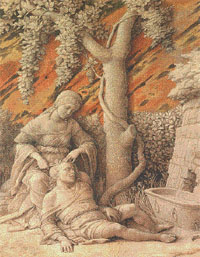
Samson and Delilah
Andrea MANTEGNA 1500-6
Inscribed on the tree-trunk with the proverb: foemina
/ diabolo tribvs / assibvs est / mala peior Linen, 47 x 36.8 cm No. 1145.
Purchased, 1883.
This picture is based on the biblical story of Samson
and Delilah. It is painted to look like a cameo a miniature relief in the
different strata of a precious stone. Such carvings by Roman gem-cutters
were admired and collected in Mantegna’s circle.
Vasari praises Mantegna’s ability to foreshorten:‘he
showed painters a much better method of foreshortening figures from below
upwards, which was truly a difficult and ingenious invention.’ The picture
is considered a late work on stylistic grounds
Andrea Mantegna (c. 1431 – September 13, 1506) was
an Italian Renaissance artist. A serious student of Roman archaeology and
son-in-law of Jacopo Bellini. Like other artists of the time, Mantegna
experimented with perspective as he thought best, e.g., by lowering the
horizon in order to create a sense of greater monumentality. His flinty,
metallic landscapes and somewhat stony figures give evidence of a fundamentally
sculptural approach to painting. He led a workshop that was the leading
producer of prints in Italy before 1500.
Samson and Delilah
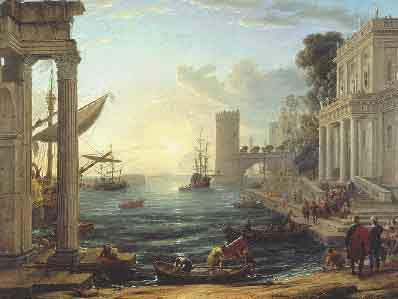
The Embarkation
of the Queen of Sheba
Composition and Proportion
The composition is
rigorously organised.
There is a simple
perspective scheme using a single vanishing- point.
The canvas is roughly
divided into fifths. The architecture and horizon
are placed in a
balanced way within this grid.
This produces a clearly
ordered picture, which conveys an
impression of permanence.
Claude brings it
to life with much detail and the whole
painting with morning
light.