 |
 |
 |
 |
|
|
|
|
|
|
 |
 |
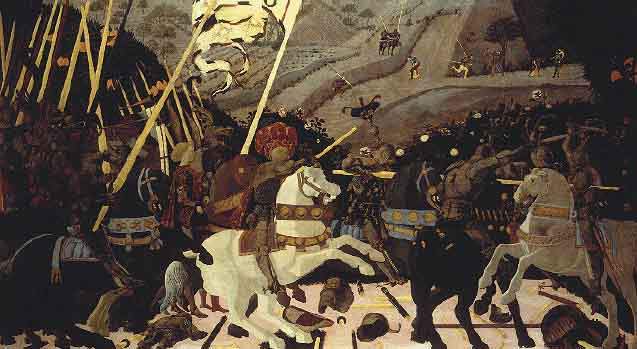
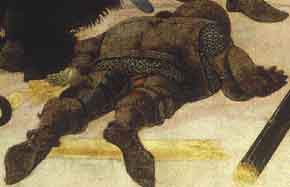
The Battle of San Romano Paolo UCCELLO After 1432 Paolo Uccello (born Paolo di Dono, 1397 – December 10, 1475) was a Florentine painter who was notable of visual perspective in art. Giorgio Vasari in his book Lives of the Artist wrote that Uccello was obsessed by his interest in perspective and would stay up all night in his study trying to grasp the exact vanishing point. He used perspective in order to create a feeling of depth in his paintings and not, as his contemporaries, to narrate different or succeeding stories. His best known works are the three paintings representing the battle of San Romano (for a long time these were wrongly entitled the "Battle of Sant' Egidio of 1416").Paolo worked in the Late Gothic tradition, and emphasized colour and pageantry rather than the Classical realism that other artists were pioneering. His style is best described as idiosyncratic, and he left no school of followers. He had some influence on twentieth century art and literary criticism. |
|
Born 1397 Florence Died 10 December 1475 Florence Nationality Florentine Field painting Training Lorenzo Ghiberti Movement International Gothic Full
title ‘Niccolò Mauruzi
This
brilliantly coloured and structured painting depicts part of the battle
of San Romano,
The
panel is one of a set of three. The other two are in Florence and Paris.
The
pictures reflect both courtly decoration, such as tapestry, and
The
Battle of San Romano
Paolo
[Uccello]... discovered a method for standing his figures firmly on the
|
|
|
|

Click for - India's True Portal |
| Privacy Policy for LiveIndia.Com |