 |
|
|
|
|
|
|
|
|
|
|
|
|
|
|
|
 |

 |
Baidyanath Jyotirlinga
Shiva Temple
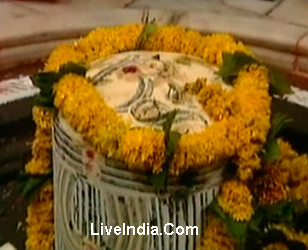
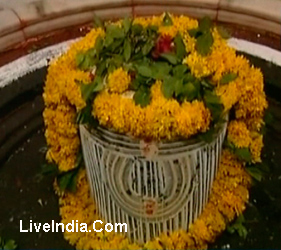
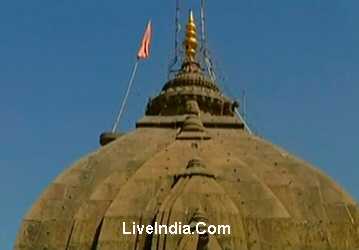
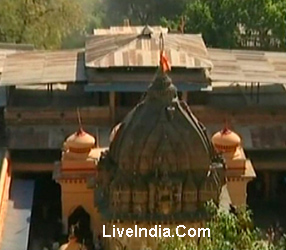
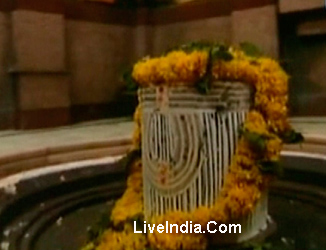
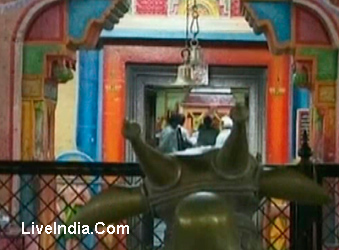
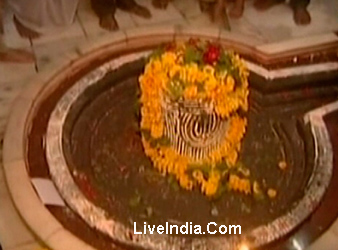
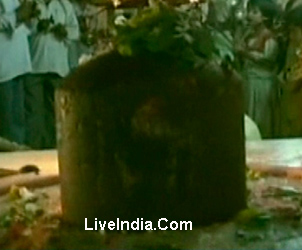
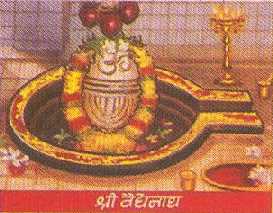
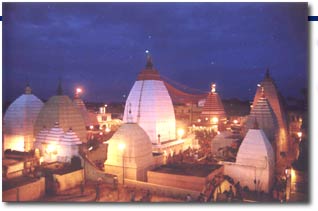
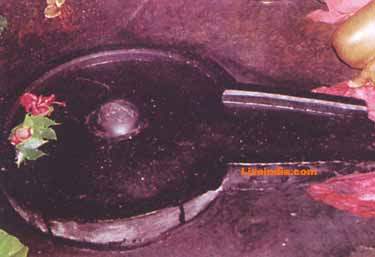
Baidyanath The temple of Baidyanath faces the east and is a plain stone structure with a pyramidal tower which rises from a square base to a height of 72 feet from the ground. To the east of the northern verandah of the temple there is a large vat into which flows the water and milk offered as ablution. The lingam is of a cylindrical form about 5 inches in diameter and projects about 4 inches from the centre of a large slab of basalt. It is not possible to ascertain how much of the lingam is buried. The top is broken and has uneven surface. There are different porches in the temple. One porch leads to the cell where the lingam is fixed. The second porch is in front with a row of pillars spanned by blocks of basalt and on the right side there is a sandstone image of a bull. There are bells fixed in the ceiling and pilgrims are supposed to pull the bell-ropes to announce their approach to the divinity. The courtyard has eleven other temples |
|
| According to other traditions,
not noticed in any purana, the 'LINGAM' (Lord Shiva) lay neglected after
the death of Ravan until it was noticed by a rude hunter, Baiju, who accepted
it as his God and worshipped daily; proclaiming to the world as the Lord
of Baiju (Baidyanath).
Some of the purans ascribe the advent of Baidyanath of Deoghar to the 'Satya Yug', or the first age of the world. When Sati, the wife of SHIVA and the daughter of DAKSHARAJA committed suicide in consequence of the discourtesy shown to her husband by Raja Daksha; the heart falling spot of Deoghar (Baidyanath) of SHIVA'S Sati attends is sanctity. Hence the place had been called 'SIDDHAPEETH' .
Sir William Hunter in the annuals of rural Bengal related the Santhal tradition of Baidyanath with Santhals but unfortunately many historians say it has no inference. Current Condition : There are 22 temples in the same campus of different Gods and Goddessess among which Lord Shiva is embraced being as supreme. Modern concepts ascribe that the shrines are of both old and new styles. The temple of Shiva is 72 feet tall and it is lotus Shaped. The top contains three ascending shaped gold vessels that are compactly set, which is donated by Giddhor King. Besides these pitcher shaped vessels, there is a 'PUNCHSULA' (Five knives in Tridenta shape), which is rare. In inner top there is a eight pettaled lotus jewel (CHANDRAKANTA MANI). The 'LINGAM' (Lord Shiva) is also very rare.
It is known as 'JYOTIRLINGAM'. In entire India these Jyotirlingams are twelve, among those this is one. This is described in 'ShivPurana' (Holy book of Hindus).
The greatness of this temple lies in this fact that in this modern age the scientists are unable to open one cross ventilated door, so it is also said that Vishwakarma (God's Engineer) had erected this temple. In the north of the temple there is one holy pond known as 'SIVGANGA', regarding which there are several myths in the society. Its present condition is brought by king of Laxmipur state (Late Thakur Pratap Narayan Dev). Adjacent to it there is another old pond (Mansinghi) made during 16th century by Swami Raja Man Singh (Jaipur). Though it's original citizens are Panari and Adivasis, now several religious persons are residing. But priest group is of Brahman whose deep relations is related with the temple. But historical facts say that 'Maithil Brahmans' came here in the end of 13th century and beginning of 14th century from Mithila Kingdom known as Darbhanga. Radhi Brahmans came here from Central Bengal during 16th century, Kanyakubja also came from Central India during same phase. These all priest groups are not only priest but they assist Shivas worshipper by giving shelter and other help. Their unbounded contribution can be seen in maintaining the sanctity of the temple. The head priest is a Maithil Brahman. His post is known as 'Sevayat' who is not only head priest but religious administrator too. Worshippers have a very revered approach to him. Presently the administration of the temple is under one Trust whose members are from local panda (Priest) community representative of king Giddhor and Deputy Commissioner Deoghar being receiver. Lord Shiva is not a myth for the people of Deoghar, rather it's a live concept. Shiva is not the only source of living. In fact it splashes the love and Bhakti to each and everyone. This 'JYOTIRLINGAM' is in fact related with the cultural way of wishing people in myriad occasion. 'Har Har Mahadav' is a slogan of trust and victory.
The whole world takes boon from this God. This religious city has kept a long chain of great SADHAK and personalities and artists, but this entire chain remains fake just before the name of Lord SHIVA. Even after some bhakts cannot be forgotten. This group contains Hindu, Muslims, Christians etc. These persons were belonging with politics medieval feudal lords in previous days. In one side is one Muslim family (Halim Saheb) who provides worshipping materials for Shiva and the next aspect is daily evening (SHRINGAR) worship which cannot be held without the garland of prisoners of Deoghar jail. In one way the king of Giddhor donates the heavy gold vessels to temple and in other way several sociopolitical figures Vinoba Bhave, Mahatma Gandhi, Pt. B. N. Jha, Ram Raj Jajware tries their best to complete their mission by opening the gate of the temple for other sectors of people. Inspite of having such a large contradiction, the people here remain unafraid and continue their life with total freedom like fast flowing mountaineous rivulets |
 |
 |
| More Pictures and ....Virtual Tour.......... |
|
|
|
|
|
|
|
|
|
|
|
|
|
|
|
| Shankaracharya Temple - Kashmir | Gangeshwar Temple Diu | Other Details of Shiva |

|
||
 |

 |
 |
 |
 |
 |
 |
 |
Rajesh Chopra's comments Please |
 |
 |

All rights reserved. No part of this publication and other sites of under liveindia.com may be transmitted or reproduced in any form or by any means without prior permission from the publisher Live India Internet Services or Rajesh Chopra, L.C.Premium Cables, 1826, Amar Nath 2nd Building, Bhagirath Palace Delhi - 110006, India. Liveindia.com or Mr.Rajesh Chopra is not responsible for any wrong information under this site, For confirmation of any information it is recommended that you can reconfirm from yours end. |