 |
|
|
|
|
|
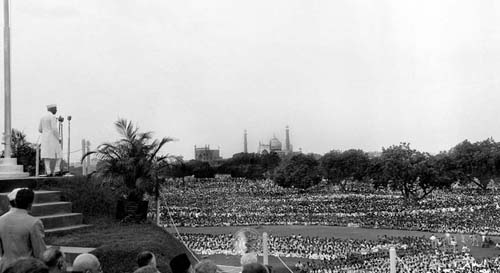
The Prime Minister, late Sh. Pt.Jawahar Lal Nehru
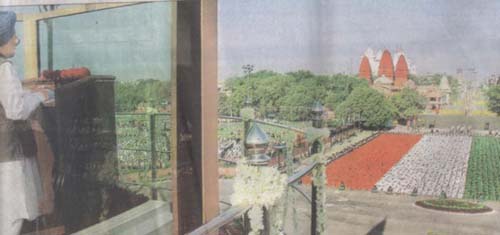
Indian independence day-august 15 On 15 August 1947, India attained freedom from the British Rule. Every year, August 15 is celebrated as the Independence Day in India. This national festival is celebrated with great enthusiasm all over the country. The Independence Day of any country is a moment of pride and glory. On this special occasion, rich tributes are paid to the freedom fighters who sacrificed their lives and fought to free their motherland from the clutches of the oppressors - British who ruled the country. The British, had initially come for trade but gradually took over the total administration of the country. At the strike of midnight of the August 15, 1947, India shook off the shackles of British Rule and became free. It was a night of celebration all over the country. Commemorating the day India attained freedom (15th August); Independence Day is celebrated with flag hoisting ceremonies and cultural programmes all over the country. The main program is held at the Red Fort where the Prime Minster unfurls the National Flag and it is saluted by Guns. The Prime Minister's speech at the Red Fort in Delhi is a major highlight. Patriotic presentations by school children add colors to the celebrations. Delhi’s skyline gets dotted with thousands of kites taking to the sky this day. Similar programmes are held at all the State capitals also. The preparations begin a month in advance. Roads are decorated with flags and buntings. Buildings of national importance are illuminated. Republic Day..... |
 |
As india celebrates its Independence day,lets remember the great Patriots who laid down their lives for our Independence Tatia Tope: Tatia Tope was a hero of the fight for freedom in 1857. His very name made the mighty English Generals tremble. Deceived by his friend, he faced death like a hero, for the sake of his country. He was the Supreme commander in the War of Indian Independence, which in 1857, had challenged the hold of the British over India. It was he who, more than anybody else, shook the mighty British Empire to its foundations. Holding aloft the flag of freedom, he sought to break the chains of slavery and fought the military might of the English heroically. His name had become a household word for bravery. Jhansi Lakshmi Bai: Lakshmi Bai was the great heroine of the First war of India Freedom. She lived for only 22 years. She became a widow in her eighteenth year. Jhansi, of which she was the queen, was in the grip of the cunning, cruel British. She was the embodiment of patriotism, self-respect and heroism. She was the queen of a small state, but the empress of a limitless empire of glory. She led her troops to battle against the British in the Revolt of 1857. She was one of the first women martyrs of the country. Bal Gangadhar Tilak: Bal
Gangadhar Tilak was a great Sanskrit scholar and astronomer. He fixed the
origin and date of Rigvedic Aryans, which was highly acclaimed and universally
accepted by Orientalists of his time. His role in Congress and advocating
Home Rule for India were enormous. His newspaper (Kesari) founded in 1881
is going strong even today. He was Guru to V.D. Savarkar and hundreds of
nationalists and thousands of Indians. He led the Indian Freedom Movement,
till 1920, his death. After him Gandhiji took over. Although Gandhi accepted
Gokhale as his mentor, in practice, he adopted all of Tilak's ideas of
Swadeshi and of social reform.
Surendranath Banerjee: Surendranath Banerjee was one of the early leaders in the history of the Indian freedom movement. He was a great leader and at the same time professor, newspaper editor and social reformer. Due to his refusal to accept defeat he was known as 'Surrender Not'. He served as the President of the Indian National Congress twice, in 1895 and 1902. He became the editor of a paper called "Bengalee" from 1878 and wrote fearlessly on patriotism, freedom, unity and culture Bhagat Singh: Bhagat Singh
was born in September 27, 1907 in the village Banga of Layalpur to Mata
Vidyavati and Sardar Kishan Singh. Bhagat Singh grew up in a patriotic
atmosphere as his father and uncle, were great freedom fighters and were
put in jail many times by the British. Bhagat Singh, along with the help
of Chandrashekhar Azad, formed the Hindustan Socialist Republican Army.
The aim of this Indian revolutionary movement was defined as not only to
make India independent, but also to create "a socialist India."
M.K.Gandhi: Mohandas Karamchand
Gandhi became one of the most respected spiritual and political leaders
of the 1900's. Gandhi helped free the Indian people from British rule through
nonviolent resistance, and is honored by his people as the father of the
Indian Nation. Gandhiji stayed in South Africa for 21 years working to
secure rights for Indian people. He developed a method of direct social
action based upon the principles of courage, non-violence and truth called
‘Satyagraha.’ He believed that the way people behave is more important
than what they achieve. ‘Satyagraha’ promoted nonviolence and civil disobedience
as the most appropriate methods for obtaining political and social goals.
In 1915 Gandhi returned to India. Within 15 years he became the leader
of the Indian nationalist movement. Using the tenets of ‘Satyagraha’ he
led the campaign for Indian independence from the British rule.
Vallabh Bhai Patel: Vallabh Bhai Patel, the iron-man of India, was born on 13th October, 1875, in a small village Karamsadh of Bombay region. The British government declared to confiscate all the lands of farmers. Patel forced the government to amend the rules. He brought together the farmers and encouraged them and hence got the title of 'Sardar' and thus became famous. With great wisdom and political foresight, he consolidated the small kingdoms. The public was with him. He tackled the Nizam of Hyderabad and the Nawab of Junagarh who intially did not want to join India. There were a lot of problems connected with the reunion of the numerous states into India. Sardar Patel's untiring efforts towards the unity of the country brought success. Due to the achievement of this massive task, Sardar Patel got the title of 'Iron Man'. Maulana Abul Kalam Azad: Independent India's first Education Minister. He was given the chrono-grammatic name of Firoz Bakht (of exalted destiny) but commonly called Muhiyuddin Ahmad. He was imprisoned several times by the British. From 1920-1945, Abul Kalam Azad was in and out of prison a number of times. He was twice elected President of the Indian National Congress in 1923 and in 1940. He was the the youngest person to be elected the President of the Congress. He continued as President of the Congress till 1946 and when India became Independent. He started Urdu weekly, "Al-Hilal". The paper was amazingly forceful. It was a patriotic weekly. This antagonized the Britishers. Jawaharlal Nehru: Jawaharlal
Nehru was a leader of the socialist wing of the Indian National Congress
during and after India's fight for independence from the British empire.
He became the first Prime Minister of India when the country became a independent
in 1947 and remained Prime Minister until his death in 1964. Nehru embodied
a synthesis of ideals: politically an ardent nationalist, ideologically
a pragmatic socialist, and secular in religious outlook, Nehru possessed
a rare combination of intellect, breadth of vision, and personal charisma
that attracted support throughout India. During the freedom struggle, he
courted arrest many a times, and had been jailed 14 years in all. He was
elected Congress President five times, and it was under his influence in
Lahore, that the Congress adopted complete freedom as its goal.
|
 |
|
Copyright
© 1998-2006 LiveIndia.com and liveworldtours.com All rights
reserved
|