 |
 |
|
|
|
|
 Advertise here |
|
|
 |
 |
| How to Buy a Bra
Its been around for ages, survived all sorts of changes, even survived the feminist barbering revolution, and come out on top! ......., lingerie designer for Marks and Spencer tells you how to buy the perfect bra. They come in all shapes and sizes. And something women across all ages and cultures have realized that it is essential to wear a bra – a good bra. We all know how a bad bra, especially if you have a fuller bust, can cause your muscles to stretch beyond repair a leave with a ‘saggy’ shape. Here are some tips that will ensure you buy the right kind of bra. Fabrics:Watch out for rigid (non-stretch) fabrics such as woven cloth in which it is very difficult to get a good fit. Moreover, it can shrink in washing and does not suit most women whose bust size fluctuates during the month. Stretch fabrics always give more support as well as a better fit. Try Lycra blends as opposed to knitted jersey (non Lycra) fabrics, which get baggy after a while and do not give adequate supportLace:Watch out for rigid lace, which can scratch and cut you, more so in our tropical Indian climate. Try stretch laces with Lycra which are now available with cotton blends which are soft, strong, cool and let your skin breathe easySmoothness:If you wear close fitting clothes, avoid bras with lots of frilly straps and bows or highly topstitched obvious seam lines. Instead buy a ‘moulded’ (seamless) bra or one with a small dartUnderwrites:Only buy wired bras if they are a perfect fit as a wire packing can lead to health problems. The wires should sit flat against your ribcage and not on your actual bust with no gap between the garment and your body. The wire bras should be made soft, but strong casing. Wired bras tend to give more support to a fuller bust and more definition to a smaller bust.
Soft Bra (Unwired): These are generally more comfortable and can give good support to a fuller bust if they are made in medium or firm control fabrics Straps:They must be adjustable and have good elasticity. If they are totally rigid they will cut your shoulders and if they are loose and springy they will not give adequate supportFastenings:A single hook width looks very neat, but it is not practical for fuller busts. A fastening with two or three hooks is much more comfortable and supportive for everyday wear. All straps should have adjustable levels for the hooks to be tightened or loosened to accommodate fluctuation of weight or washing changes. A Stretch bra, with Lycra, will get bigger over time and a firm cotton woven bra will shrink.People often wear bra, which is too big in size and too small on the cup, which is shown by the elastic riding up the back instead of sitting straight at a horizontal angle from the front. And this is one of the biggest mistakes women do in maintaining their bodies. Unless a bra fits just right, it could ruin the shape of your bust if it is too big. Alternatively, if it is too small, in extreme cases it could even leave you vulnerable to tumours. Never buy a bra without trying it on and never get anyone else to buy it for you. Because nobody knows your body like you do. Things to check in the Fitting room
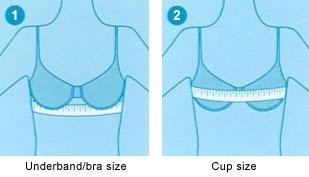
How to Measure Yourself:Measure your rib cage under the bust in inches and add four five inches to bring it to an even number. This measurement is the bra size; 32, 34, 36, etc. Measure across the top of your bust without a bra on. Subtract the bra size measurement from this new measurement. The balance you are left with is your cup size: AA, A, B, C, D, DD etc. If the first measurement is 29-30 you are a size 34". If the second measurement is 35" and you subtract this from the second measurement you are left with 1" (B cup).Your cup sizes less than 1" = AA; No difference = A; 1" = B;
2" = C; 3" = D; 4" = DD
How to Measure Bra Size in India
Q: Hi, I am Dhana I am 18
years. My breast size is very big and it started hanging .can u suggest
me any help plz. Its looking odd to me and iam feeling bad about it. Thanks
for replying.
Q: My daughter is 16 already,
yet she is completely flat. It is not the matter of a small chest - she
hasn't even started developing one! This is having a huge impact on her
self esteem, and I'm starting to worry about her health. She's even tried
putting weight on, but there is still no chest, and instead a huger belly.
Is there something wrong with her body?
Q: My daughter is 14 years
old and almost 15. She has no bust at all and is completly flat. Please
tell me what I can do to help her.
Q: Please help me that how
can I firm my breasts, because shape of my breasts is very different from
others. my nipples are very near to the arms and a wide area is between
the two.
Q: Hi my daughters 11 turning
12 march 2005 and she has no breast at all there flat she tries drink milk
but no help what can she do to have bigger breasts?
|
|
|
|
|
|
|
|
|
|
|
|
| Home | How to become a model |
 |
 |
|
 |
 |
|
( The Trade Marks Act, 1999, No. 01403083. User Since : 01/04/1997 ) 
All rights reserved. No part of this publication and other sites of under liveindia.com may be transmitted or reproduced in any form or by any means without prior permission from the publisher Live India Internet Services or Mr.Rajesh Chopra, L.C.Premium Cables, 1826, Amar Nath 2nd Building, Bhagirath Palace Delhi - 110006, India. Liveindia.com or Mr.Rajesh Chopra is not responsible for any wrong information under live india's sites, For confirmation of any information it is recommended that you reconfirm it from your end. |