 |
 |
|
|
|
|
 |
Nails
|
The condition of nails reflect the quality of tissue production in the body as nails are considered to be the waste product of bones (asthi dhatu) Healthy nails are pink, smooth and evenly shaped. The root cause of nail disorders like splitting and flaky nails, white spots, vertical ridges or discoloration of the nail bed is an improper diet. Vata type nails are irregular in shape, pale, rough and brittle and bitten. A person with Pitta as the predominant dosha has oval, soft, strong and flexible nails while Kapha type nails are square, thick, large and very white. Sesame seeds, sunflower seeds, dairy products, nuts, dried fruit and dark green leafy vegetables encourage healthy nail growth. To make the hands soft and nourish the nails, prepare a cream of almond oil and honey and leave it on overnight.
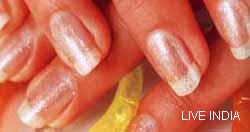
Hands and feet are often the most neglected areas, yet the way they look gives our inner secrets away. Cared-for nails are a sign that the rest of our body is well looked after too. Vitamin deficiencies show up as weak and splitting nails; insecurity appears as nail biting; stress can slow growth; Spend a little time and effort sorting our dry, flaky nails, and hard, rough skin, and thanks to the latest technical advances in nail care, a perfect set of strong, healthy nails in now within reach. Home Manicure
Thirty-minute pedicure
|
 |
 |
|
Practicality rules over all. The shape is softly rounded. The look lies with medium-sized nails with a French manicure, with clear varnish down the length and white crescents at the tips (check out the Tips and Toes Manicure Kit). The colors in vogue are a trifle more complicated. It’s red for the night – we are talking pure fire-engine matte red, the sort of red that makes men go week at the knees and declares you’re a bad girl. The wishy-washy pinks and purples which held sway for a bit and the grotesque steel gray, which became ubiquitous shade for the wannabe hep cats, have all been relegated to the back. The neon greens and blues are best left to the teen brigade where they are slowly crawling down the ladder from hip to has-been. Transparent camels and frosted sables are the shades to watch out for on toes. These are the shades they’re showing off in open toed sling-backs in Hollywood. They’re also wearing matte and opalescent whites. However, since both pale and pearly nail polish tend to highlight any bumps or ridges, prime nails with a clear base coat first. Shimmer is so big that Estee Lauder, Yves Saint Laurent and L’Oreal seem to have got an entire range to boast of. These are shades straight from your heart, but with a twist. Sable with an oil slick effect, or opalescent nail polish with a petrol sheen (the multicolored rainbow look) are what are giving nails the hip hop look right now. The surest, softest and the most chic look amongst the haves is that of sheer coat – the transparent shines that just lets the soft sheen of gloss show the true shade of the nail underneath, but this is a look of the grave. For the woman who has more chores like cooking and cleaning to be done, such daredevil bravery is uncalled for…she should get herself a skin tone matte, or a light peach opalescent. It doesn’t show as much when it chips. Also, it’s not enough just to have manicured nails today. The hippest craze is to have them stenciled, painted, even pierced, so that you don’t see nails in the same light again. Even the best shades will fall flat on hands that are not maintained well. Make sure to give them a manicure once a fortnight at home or in a salon. Massage a hand cream into your hands at least a couple of times a week, and make sure you wear gloves when you’re washing up or cleaning. And above all, keep your nails at a tolerable length – shall we say one that will allow you to dial from an old telephone instrument. |
| Step by Step to Beautiful
Nails
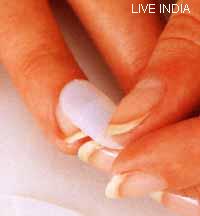
Remove all traces of nail polish with a cotton wool pad soaked in remover. Pay special attention to the corners, where streaks of nail color may remain. Soak hands in a bowl of warm, soapy water with a pinch of salt Massage cream into the cuticle, all around the nail and down to the first joint of the finger. Push back the cuticle with a cuticle stick. Clean your nails with a soft brush Give your hands a light scrubbing with a pumice stone, to gently cleanse the skin. Cut your nails to the desired length File your nails to prevent splitting and flaking. Use the coarse side of the nail file to reduce the size of the nail, and the fine side to shape and seal edges. Snip cuticles with a cuticle cutter. You can also apply a liquid cuticle remover (an alkaline based liquid with a moisturizing agent) to the nails to further soften dead skin cells which collect around the nails groove Remove dirt lodged underneath nails Change the water in the bowl and add a few drops of antiseptic solution. Apply hand cream and give yourself a thorough massage to remove dry or loose skin cells. This improves the circulation and allows hands to become supple and soft to the touch. At Villa Appearances, a vibratory massager is used to induce softness Steam hands with a soft towel and relax. You are done with a the manicure. But if you would like to take things a step further, the Deluxe Rose Manicure at Villa Appearances has a few extra steps, for those who like to be spoiled Apply a thick layer of cream
to your hands
Nail NecessitiesMix two tablespoons of powdered gelatin in a glass of milk or fruit juice and drink daily in the morning. This is a sure cure for brittle and splitting nails.To soften hands soak them in a mixture of honey and orange juice for about ten minutes. Pat dry and apply hand cream. Lemon juice is a whitening agent and can also be used for removing stains from fingers and nails. Apply and leave for 15-20 minutes. Remove with warm water, pat dry and follow with a rich moisturising cream (lemon juice can be drying, so you must compensate). Take three tablets of calcium lactate daily with a warm glass of milk for strong bones, nails and teeth. To repair the damage done by soaps and hard detergents rub equal amounts of rose water and glycerin to the hands. Exercise your hands daily
– like any other part of your body, they need a workout, tool. Bend your
fingers up and down 15-20 times daily. Pep up the circulation by taking
the fingers of one hand in the other and gently pulling each finger.
|
 |
|
|
|
|
|
|
|
|
|
| Home | How to become a model |
 |
 |
|
webmaster
LIVE INDIA
 |
|
( The Trade Marks Act, 1999, No. 01403083. User Since : 01/04/1997 ) 
All rights reserved. No part of this publication and other sites of under liveindia.com may be transmitted or reproduced in any form or by any means without prior permission from the publisher Live India Internet Services or Mr.Rajesh Chopra, L.C.Premium Cables, 1826, Amar Nath 2nd Building, Bhagirath Palace Delhi - 110006, India. Liveindia.com or Mr.Rajesh Chopra is not responsible for any wrong information under live india's sites, For confirmation of any information it is recommended that you reconfirm it from your end. |
 |