 |
|
| Back to Home |
|
|
 |
| Jawaharlal Nehru was
born at Allahabad on November 14, 1889, the son of Pandit Motilal Nehru
and Swarup Rani. Motilal Nehru was a renowned lawyer of the North with
a huge practice. Jawaharlal, was brought up in luxury, had European governesses
and tutors, and was provided with a private swimming pool and tennis Courts
He was educated at Harrow and Cambridge and took the Natural SciencesTripos
from Trinity College. Later he qualified for the Bar from the Inner Temple.
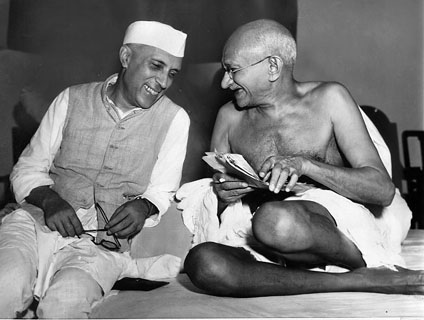
Back home he joined his father's Chambers but his heart was not in legal practice, and he also soon got bored with the life of ease upper class Indians were accustomed to. He began to take an active interest in politics and showed early signs of being a radical - he disliked the Moderate group to which his father belonged. Mrs. Besant's internment caused a change heart among some Moderates and his father too drifted away from the orthodox Moderate position. In 1916 Jawaharlal married Kamala. The Jallianwala Bagh massacre, Gandhiji's satyagraha movement and other events swept him completely into the national struggle. It did not take him long long to emerge as a great national leader. When he was only 40 he was elected to preside over the momentous Lahore session of the Congress in 1929- it was here that the resolution on Puna Swaraj was adopted. He often came into conflict with his father who was for Dominion Status. The two loved each other deeply in spite of their differences and it is likely the son influenced the father. He had differences with Gandhiji also but these did not come in the way of his faith in the leadership of the Mahatma. Jawaharial so endeared himself to the latter that he wrote: "He is pure as crystal, he is truthful beyond suspicion. He is a knight sans peur, sans reproche. The nation is safe in his hands." Gandhiji nominated him as his political heir. Jawaharlal spent many years of his political career in gaol. His life of sacrifice earned him the affection of his countrymen. Indeed next to the Mahatma he was our most popular leader. India and its people became his major concern and during his tour of the country he was moved by the vast crowds that came to see him. He was a man of many interests, fond of nature, particularly the mountains. He was some what impetuous and in him there was a wonderful combination of the man of action and the man of thought. He wrote sensitively and his several books brought hirn international fame-"An Autobiography", "Glimpses of World History" and "Discovery of India" are among the more notable of his publications. It is difficult to say which of Panditji's two periods is more memorable- the one before freedom or the one after it. During both he played a crucial role. His prime ministership of free India was a blessing to the nation. It was mainly because of him that the country did not go to pieces during the first years of upheaval. (We do not of course forget that there were others like Sardar Patel who did much to preserve the country's integrity. Nehru often differed from the Sardar and once or twice Gandhiji brought them together.) Jawaharial Nehru was Prime Minister for seventeen years. During this period he worked to take India to the modem era and at the same time earned for it a place in the world. He himself came to be counted among the great leaders of his time, a bitter opponent of colonialism who was looked upon for inspiration by the Afro-Asian world. He will be remembered not only for the dams and laboratories he built and for laying the foundation of heavy industry. He will have his place in history as a man who had a great vision of India and the world and endeavoured to fulfil it by his action. Pandit Jawaharlal Nehru, the first Prime Minister of Independent India, was loved by the people both as a man and a leader. He stands foremost among the builders of modern India, giving it a direction towards socialism in a secular, democratic setting. Writer and historian, Nehru through his books influenced the thinking of generations of Indians and made them thirsty for a free, democratic, socialist, secular India with science and technology as its driving force. He was largely responsible with initiating planned economic development 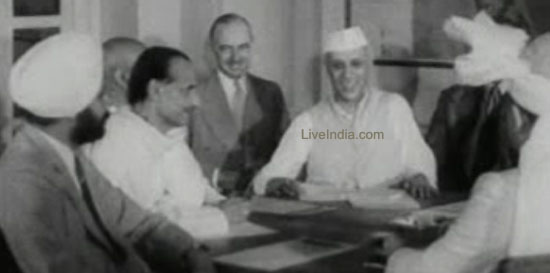 |
|||||||||||||||||||||||||||||||||||||||||||||||||||||||
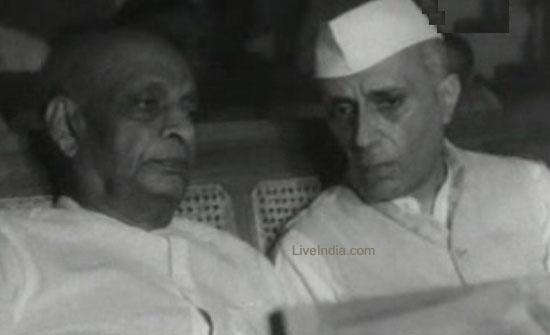
Though he wielded a power greater than that of any dictator, he never gave up democratic principles nor did he abandon his humanistic outlook, whatever be the provocation. He was a tireless fighter for right and justice, not only in India but throughout the world. Not only did he build up the foreign policy of India from the scratch, but devoted himself to the building up of one world through international peace. He tried to bring some semblance of the rule of law in international affairs. An apostle of world peace, his words were heard with great respect in the chancelleries of the world and in the United Nations. He lived in and for great causes. He left his mark on the history of the world. Nehru wrote his famous books "An Autobiography", "The Discovery of India" and "Glimpses of World History" in English while in prison. His writings bore the stamp of an intellectual with a sensitive mind and a poetic temperament. It is said of him that he could "feel" his thoughts when he wrote. He had a rare mastery of the English language and a fine sense of rhythm 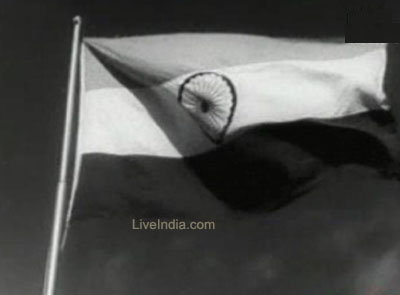
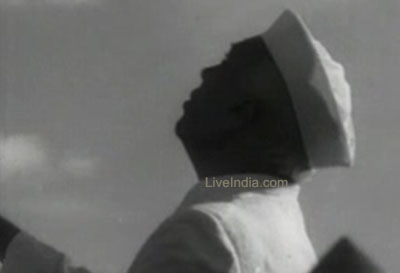
15 August, and delivered his inaugural address titled "A Tryst With Destiny" 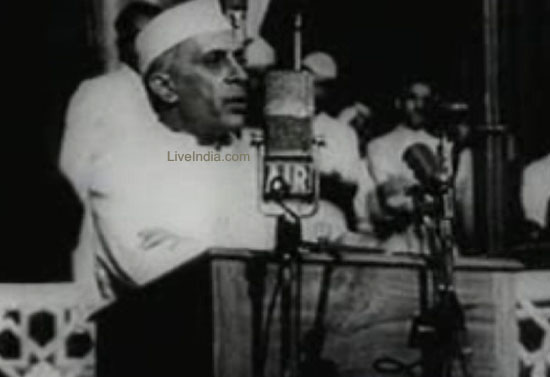
"Long years ago we made a tryst with destiny, and now the time comes when we shall redeem our pledge, not wholly or in full measure, but very substantially. At the stroke of the midnight hour, when the world sleeps, India will awake to life and freedom. A moment comes, which comes but rarely in history, when we step out from the old to the new, when an age ends, and when the soul of a nation, long suppressed, finds utterance. It is fitting that at this solemn moment we take the pledge of dedication to the service of India and her people and to the still larger cause of humanity." |
|||||||||||||||||||||||||||||||||||||||||||||||||||||||
|
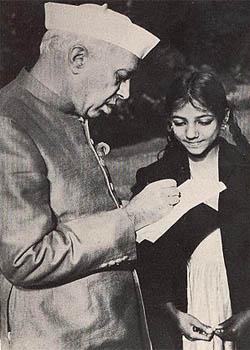
Nehru loved children;
therefore his birthday is observed as Children’s Day. For children, he
was Chacha (uncle) Nehru
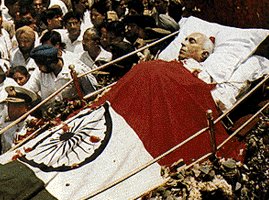
Although the Pancha Sila (Five Principles of Peaceful Coexistence) was the basis of the 1954 Sino-Indian treaty over Tibet, in later years, Nehru's foreign policy suffered through increasing Chinese antagonism over border disputes and Nehru's decision to grant asylum to the Dalai Lama. After years of failed negotiations, Nehru authorized the Indian Army to annex Goa from Portugal in 1961.See liberation of Goa. While increasing his popularity, Nehru received criticism for opting for military action. In the 1962 elections, Nehru led the Congress to victory yet with a diminished majority. Opposition parties ranging from the right-wing Bharatiya Jana Sangh and Swatantra Party, socialists and the Communist Party of India performed well. In a matter of months, the border disputes with China turned into open conflict. Nehru assumed that as former victims of imperialism (India being a colony itself) they shared a sense of solidarity, as expressed in the phrase "Hindi-Chini bhai bhai" (Indians and Chinese are brothers). He was dedicated to the ideals of brotherhood and solidarity among developing nations. Nehru, naively, did not believe that one fellow Socialist country would attack another; and in any event, he felt secure behind the impregnable wall of ice that is the Himalayas. Both proved to be severe miscalculations of China's intentions and military capabilities. Following reports of his intention to confront Chinese occupation of the disputed areas—summarised in a memorable statement that he had asked the Army to "throw them (Chinese) out" - China launched a pre-emptive attack. In a matter of months, a Chinese invasion of northeastern India exposed the weaknesses of India's military as Chinese forces came as far as Assam. Widely criticised for his government's insufficient attention to defence, Nehru was forced to sack the defence minister Krishna Menon and accept U.S. military aid. Nehru's health began declining steadily, and he was forced to spend months recuperating in Kashmir through 1963. Upon his return from Kashmir in May 1964, Nehru suffered a stroke and later a heart attack. He died in the early hours of 27 May 1964. Nehru was cremated in accordance with Hindu rites at the Shantivana on the banks of the Yamuna River, witnessed by hundreds of thousands of mourners who had flocked into the streets of Delhi and the cremation grounds.
|
|||||||||||||||||||||||||||||||||||||||||||||||||||||||
Welcome to Rajesh Chopra's Guest Book and comments Please |
| Back to Home |
 |
 |
 |
 |