 |
|
|
|
|
We record our homage and deep admiration for the Womanhood of India who in the hour of peril for the motherland forsook the shelter of their homes and with unfailing courage and endurance stood shoulder to shoulder with their menfolk, in the frontline of India’s national army to share with them the sacrifices and triumphs of the struggle”. From a Resolution passed on January 26, 1931. When the history of India's fight for Independence comes to be written, the sacrifice made by the women of India will occupy the foremost place - Mahatma GandhiJawaharlal Nehru had remarked, when most of the men-folk were in prison then a remarkable thing happened. Our women came forward and took charge of the struggle. Women had always been there of course but now there was an avalanche of them, which took not only the British Government but their own menfolk by surprise. The entire history of the freedom movement is replete with the saga of bravery, sacrifice and political sagacity of great men and women of the country. This struggle which gained momentum in the early 20th century, threw up stalwarts like Mahatma Gandhi, Lala Lajpat Rai, Motilal Nehru, Abul Kalam Azad, C. Rajagopalachari, Bal Gangadhar Tilak, Gopal Krishna Gokhale, Jawaharlal Nehru and Subash Chander Bose. Their number and stature often gives us an erroneous impression that it was only a man’s movement. But it is not so. Many prominent women played a leading role in the freedom movement.The important place assigned to women in India dates back to the time of the Vedas and Smritis. Manu declared that where women were adored, Gods frequented that place, During the Vedic age the position of women in society was very high and they were regarded as equal partners with men in all respects. Who had not heard of Maitri, Gargi, Sati Annusuya and Sita? In keeping with this tradition, burden of tears and toils of the long years of struggle for India’s freedom was borne by the wives, mothers, and daughters, silently and cheerfully. The programme of self-imposed poverty and periodical jail going was possible only because of the willing co-operation of the worker’s family. In the various resistance movements in the villages, the illiterate women played this passive but contributory part as comrades of their menfolk by:- Cristy Chopra- Apeejay School Pitampura Delhi. |
||||||||||||||||||||||||||||||||||||||||||||||||||||||||
|
The other remarkable woman elected to the presidentship Indian National Congress was Sarojini Naidu. She became its president.dramatic meeting with another respected leader of time, Gokhle, in 1906 was to change her life forever. His response to her fiery speech brought into her life the impact of a visionary who saw in her oratory and brilliance a leader of the future. The period from 1917 to
1919 was the most dynamic phase of Sarojini's career. During this time,
she campaigned for the Montagu Chelmsford Reforms, the Khilafat issue,
the draconian Rowlett Act and the Satyagraha. When Gandhi launched the
Civil Disobedience Movement ,she proved a faithful lieutenant. With great
courage she quelled the rioters, sold proscribed literature, addressed
frenzied meetings on the carnage at Jallianwala Bagh in Amritsar.In 1930
when Mahatma Gandhi chose her to lead the Salt Satyagraha the stories of
her courage became legion. After Gandhi's arrest she had prepared 2,000
volunteers under the scorching sun to raid the Dahrsana Salt Works, while
the police faced them half a mile up the road with rifle, lathis (canes)
are steel tipped clubs. The volunteers wildly cheered when she shook off
the arm of the British police officer who came to arrest her and marched
proudly to the barbed wire stockade where she was interned before being
imprisoned.
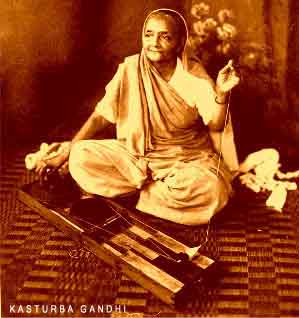
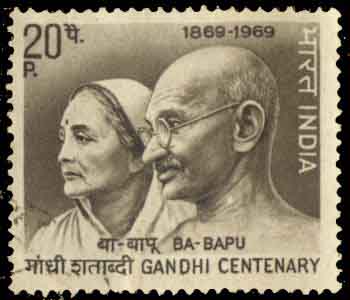
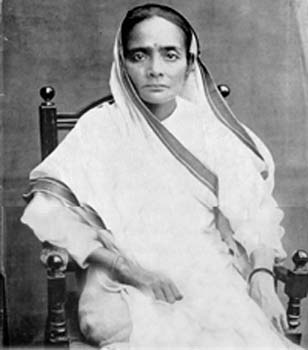
3. KASTURBA GANDHI
Kasturb Gndhi (April 11, 1869 – 22 February 1944), affectionately called Ba, was the wife of Mohandas Gandhi. Kasturba Gandhi, Mahatma Gandhi's wife joined her husband while he was in South Africa and worked with him for many years there. She was a leader of Women's Satyagraha for which she was imprisoned. She helped her husband in the cause of Indigo workers in Champaran, Bihar and the No Tax Campaign in Kaira, Gujarat. She was arrested twice for picketing liquor and foreign cloth shops, and in 1939 for participating in the Rajkot Satyagraha. Born to Gokuladas Makharji of Porbandar. Kasturba married Mohandas Karamchand Gandhi (Mahatma Gandhi) through arrangement. They were both 13 years old. At that time, she was illiterate, and so Gandhi taught her to read and write — a potentially radical move, given the position of women in India at that time. When Gandhi left to study
in London in 1888, she remained in India to raise their newborn son Harilal.
She had three more sons - Manilal (1892), Ramdas (1897), and Devdas (1900).
Kasturba suffered from
chronic bronchitis. Stress from the Quit India Movement's arrests and ashram
life caused her to fall ill. After contracting pneumonia, she died from
a severe heart attack on February 22, 1944. She died in Mahatma Gandhi's
arms while both were still in prison. He was never the same after her death.
She became an active member of Congress Party after marriage and participated in public processions during the Salt Satyagraha. She was arrested on the charge that she was a vagrant and hence not released in 1931 under the Gandhi-Irwin Pact which stipulated release of all political prisoners. Other women co-prisoners refused to leave the premises unless she was also released and gave in only after Mahatma Gandhi intervened. A public agitation secured her release. In 1932, she was held
prisoner at the Tihar Jail where she protested the indifferent treatment
of political prisoners by launching a hunger strike. Her efforts resulted
in an improvement of conditions in the Tihar Jail but she was moved to
Ambala and was subjected to solitary confinement. She was politically not
very active after her release.
On August 8, 1942, the
AICC passed the Quit India resolution at the Bombay session. The government
responded by arresting the major leaders and all members of the Congress
Working Committee and thus tried to pre-empt the movement from success.
A young Aruna Asaf Ali presided over the remainder of the session on 9
August and hoisted the Congress flag at the Gowalia Tank maidan. This marked
the commencement of the movement. The police fired upon the assembly at
the session. Aruna was dubbed the Heroine of the 1942 movement for her
bravery in the face of danger and was called Grand Old Lady of the Independence
movement in her later years. Despite absence of direct leadership, spontaneous
protests and demonstrations were held all over the country, as an expression
of desire of India’s youth to achieve independence.
Kamala Kaul Nehru (1899–1936) was the wife of Jawaharlal Nehru, leader of the Indian National Congress and first Prime Minister of India. Kamala married Nehru on 8 February 1916. Their marriage was arranged by his parents. Brought up in a traditional Hindu Brahmin family, she felt alienated amongst the more Westernized Nehrus. It was only with the involvement of the Nehrus in the national movement, that she emerged into the forefront. In the Non Cooperation movement of 1921, she organized groups of women in Allahabad and picketed shops selling foreign cloth and liquor. When her husband was arrested to prevent him delivering a "seditious" public speech, she went in his place to read it out. She was twice arrested by British authorities. Described as pretty, slim, and tender, Kamala was quiet, unobtrusive, and is thought to have had little impact on her husband. In 1917, she gave birth to a daughter, Indira Priyadarshini, who later succeeded her father as prime minister and head of the Congress party. Kamala died from tuberculosis in Switzerland while her husband was in prison. She spent some time at Gandhi's ashram with Kasturba Gandhi where she built a close friendship with Prabhavati Devi wife of Jayaprakash Narayan.
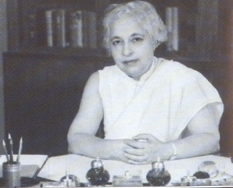
Following India's independence from the British in 1947 she entered the diplomatic service and became India's ambassador to several countries: the Soviet Union from 1947 to 1949, the United States and Mexico from 1949 to 1951, Ireland from 1955 to 1961 (during which time she was also the Indian High Commissioner to the United Kingdom), and Spain from 1958 to 1961. Between 1946 and 1968 she also headed the Indian delegation to the United Nations. In 1953, she became the first woman President of the United Nations General Assembly In India, she served as governor of Maharashtra from 1962 to 1964, after which she was elected to the Indian Lok Sabha from Phulpur, her brother's former constituency. She held office from 1964 to 1968. Pandit was a harsh critic of her niece, Indira Gandhi, after Gandhi became Prime Minister in 1966, and she retired from active politics after relations between them soured On retiring she moved to Dehradun in the Doon Valley in the Himalayan foothills. In 1979 she was appointed the Indian representative to the UN Human Rights Commission, after which she retired from public life. Her writings include The Evolution of India (1958) and The Scope of Happiness: A Personal Memoir (1979). Her daughter Nayantara Sahgal, who later settled in her mother's house in Dehradun, is a well-known novelist.
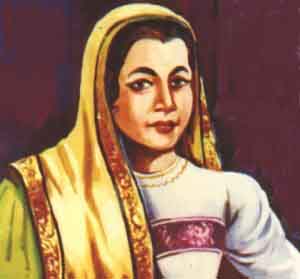
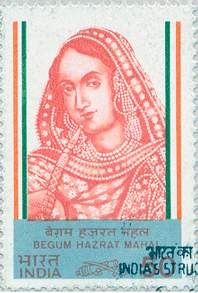
During India’s First War of independence (1857-58), she led a band of her supporters against the British, and was even able to seize the control of Lucknow. She declared her son Birjis Qadra as the king of Awadh. She is believed to have worked in close association with other leaders of the India’s First War of Independence, including Nana Sahib. When the forces under the command of the British re-captured Lucknow and most part of the Awadh, she was forced to retreat. She turned down all offers of amnesty and allowances by the British rulers. Ultimately, she had to retreat to Nepal, where she was offered asylum by the Rana prime minister Jung Bahadur. She died there in 1879 and was buried in a nameless grave on the grounds of Kathmandu's Jama Masjid. Government of India issued
a commemorative stamp in the honour of Begum Hazrat Mahal on 10th May 1984
Veera Mangai Velunachiyar...... FOREIGN WOMEN IN THE INDEPENDENCE
MOVEMENT OF INDIA
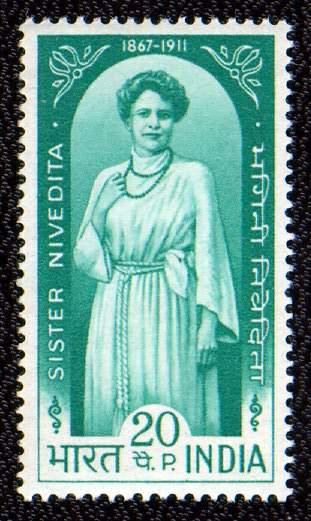
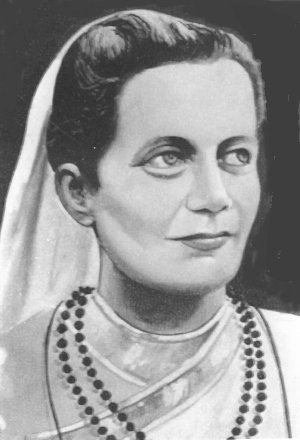
Sister Nivedita was one among the host of foreign women who were attracted towards Swami Vivekananda and Hindu philosophy. Born in Ireland on 28 October 1867, she arrived in India in January, 1898, in search of truth. She was impressed by the ideals of Womanhood in India. She once remarked that India was the land of great women. She, however, felt that Indian women needed, to cultivate among themselves a wider and broader concept of the nation, so that they could participate along with men in building a free and strong nation.She propagated for the cause of India throughout America and Europe. Swami Vivekananda described her as a real Lioness. Rabindranath Tagore regarded her as Lok-Mata and Aurobindo Ghosh as Agni-sikha. Margaret Elizabeth Noble (1867-1911), better known as Sister Nivedita, was an Anglo-Irish social worker, author, teacher and disciple of Swami Vivekananda. She met Vivekananda in 1895 in London and travelled to India (Kolkata) in 1898. Swami Vivekananda gave her the name Nivedita (which means one who is dedicated to God) on March 25, 1898. In November 1898 she started a school for girls which is now called Ramakrishna Sarada Mission Sister Nivedita Girls' High School. She worked to improve the lives of Indian women of all castes.
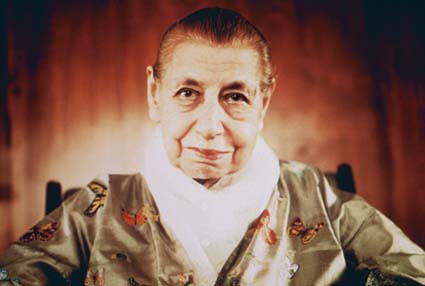
The experiences of the
last thirty years of the Mother's life were captured in the 13-volume work
The Agenda. In those years she attempted the physical transformation of
her body in order to become what she felt was the first of a new type of
human individual by opening to the Supramental Truth Consciousness, a new
power of spirit that Sri Aurobindo had allegedly discovered. Sri Aurobindo
considered her an incarnation of the Mother Divine, hence her name "the
Mother". The Divine Mother is the feminine aspect (Creative Energy) of
the Divine consciousness and spirit.
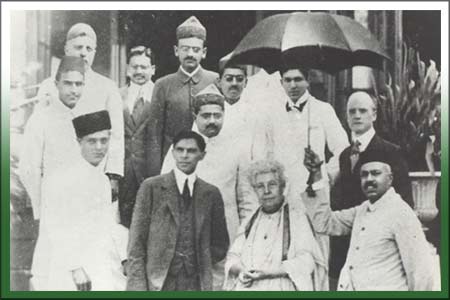
Annie Besant an Irish lady became the leader of the of the Theosophical Society. In 1902 while in London she criticized England for the conditions prevalent in India. In 1914 she joined the Indian National Congress and gave it a new direction. The idea of the Home Rule League was first discussed by her. She with the radical congress leader Tilak presented a memorial to Montagu on December 18, 1917 which gave equal rights to women in the matters of political franchise. She was the first woman president of the Congress and gave a powerful lead to women's movement in India. Annie Wood was born in 1847 in London into a middle-class family of Irish origin. She was always proud of being Irish and supported the cause of Irish self-rule throughout her adult life. Her father died when she was five years old, leaving the family almost penniless. Her mother supported the family by running a boarding house for boys at Harrow. However, she was unable to support Annie and persuaded her friend Ellen Marryat to care for her. Marryat made sure that Annie had a good education. She was given a strong sense of duty to society and an equally strong sense of what independent women could achieve. As a young woman, she was also able to travel widely in Europe. There she acquired a taste for Catholic colour and ceremony that never left her. In 1867, at age nineteen she married 26-year-old clergyman Frank Besant, younger brother of Walter Besant. He was an evangelical Anglican clergyman who seemed to share many of her concerns. Soon Frank became vicar of Sibsey in Lincolnshire. Annie moved to Sibsey with her husband, and within a few years they had two children: Digby and Mabel. The marriage was, however, a disaster. The first conflict came over money and Annie's independence. Annie wrote short stories, books for children and articles. As married women did not have the legal right to own property, Frank was able to take all the money she earned. Politics further divided the couple. Annie began to support farm workers who were fighting to unionise and to win better conditions. Frank was a Tory and sided with the landlords and farmers. The tension came to a head when Annie refused to attend Communion. She left him and returned to London. They were legally separated and Annie took her daughter with her. Annie began to question
her own faith. She turned to leading churchmen for advice. She even went
to see Edward Bouverie Pusey, leader of the Catholic wing of the Church
of England. He simply told her she had read too many books. Annie returned
to Frank to make one last effort to repair the marriage. It proved useless.
She finally left for London. Divorce was unthinkable for Frank, and was
not really within the reach of even middle-class people. Annie was to remain
Mrs Besant for the rest of her life. At first, she was able to keep contact
with both children and to have Mabel live with her. She got a small allowance
from Frank. Her husband was given sole custody of their two children.
|
||||||||||||||||||||||||||||||||||||||||||||||||||||||||
| The list of great women
whose names have gone down in history for their dedication and undying
devotion to the service of India is a long one. Gandhi squarely summed
up the strength of womanhood in his tribute to the gender:
To call woman the weaker sex is a libel; it is man's injustice to women. If by strength is meant moral power then woman is immeasurably man's superior. Has she not greater intuition, is she not more self sacrificing, has she not greater power of endurance, has she not greater courage? Without her man would not be. If non-violence is the law of our being, the future is woman. I have nursed this thought now for years. |
||||||||||||||||||||||||||||||||||||||||||||||||||||||||
|
|
||||||||||||||||||||||||||||||||||||||||||||||||||||||||
|
||||||||||||||||||||||||||||||||||||||||||||||||||||||||
| Back to Home |
 |
 |
|
| Privacy Policy for LiveIndia.Com |
|
|
 |
 |
 |
 |